
In the early 2010s, enterprise IT teams faced a problem they hadn't anticipated: employees were using Dropbox, Gmail, and Google Docs to do their jobs, completely outside the corporate perimeter. The data was leaving the building. Shadow IT was born.
A decade later, the same pattern is repeating, but the stakes are higher.
What Is Shadow AI?
Shadow AI refers to the use of AI tools, models, and agents by employees without the knowledge or oversight of IT, security, or compliance teams. It includes:
- Developers pasting proprietary code into ChatGPT to debug it
- Sales reps using Claude to draft proposals with customer data
- Finance teams using Copilot to summarize contracts that contain non-public information
- Engineers building internal tools that call LLM APIs without any governance layer
None of these activities are malicious. They're people trying to do their jobs faster. But from a risk management perspective, they create exposure that's difficult to quantify and even harder to remediate.
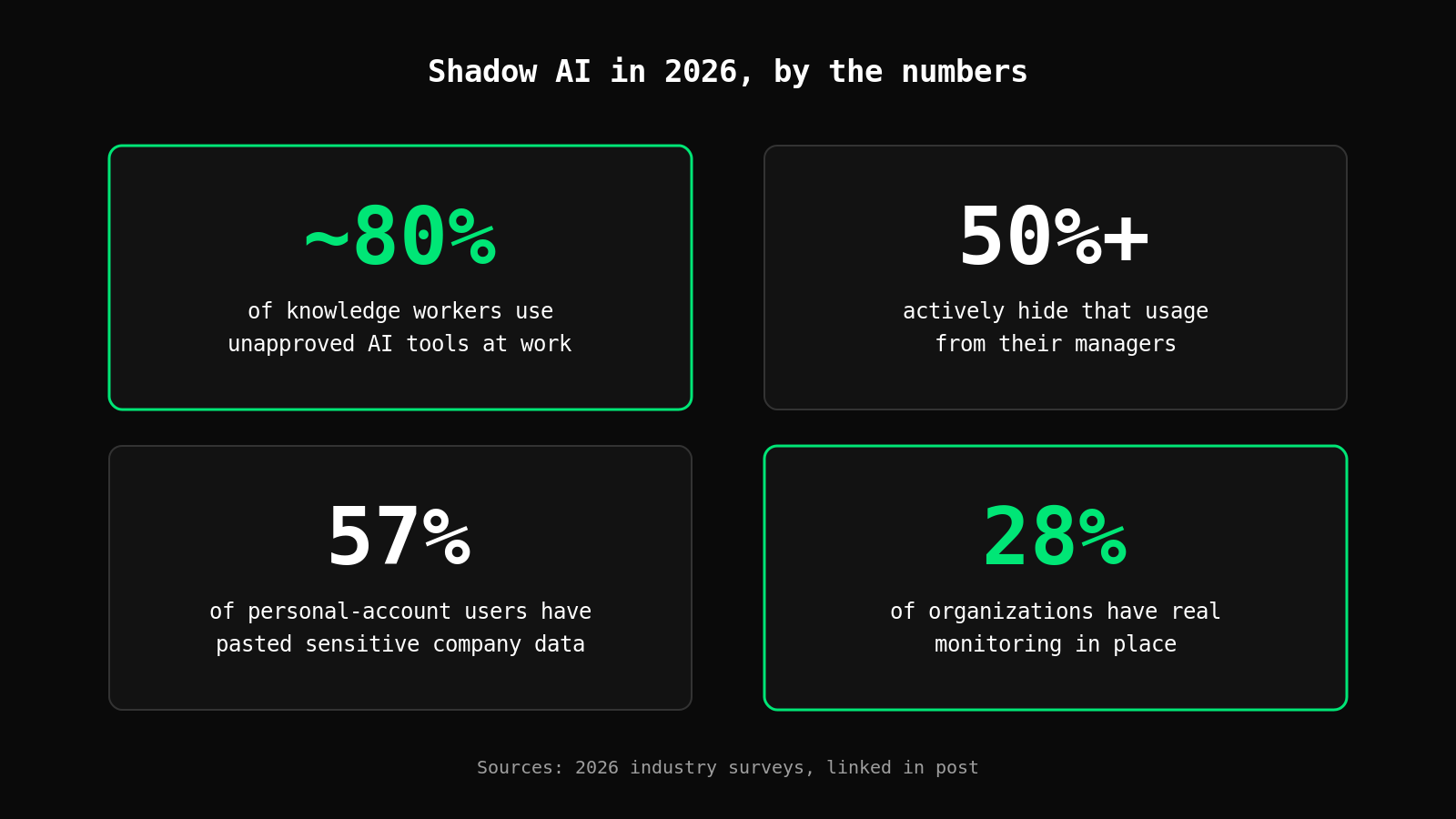
And it's not a fringe behavior. Industry research from 2026 puts the number of knowledge workers using unapproved AI tools at close to 80 percent, with more than half actively concealing that usage from their managers. Meanwhile, only about 28 percent of organizations have real monitoring in place.
Why Shadow AI Is Different from Shadow IT
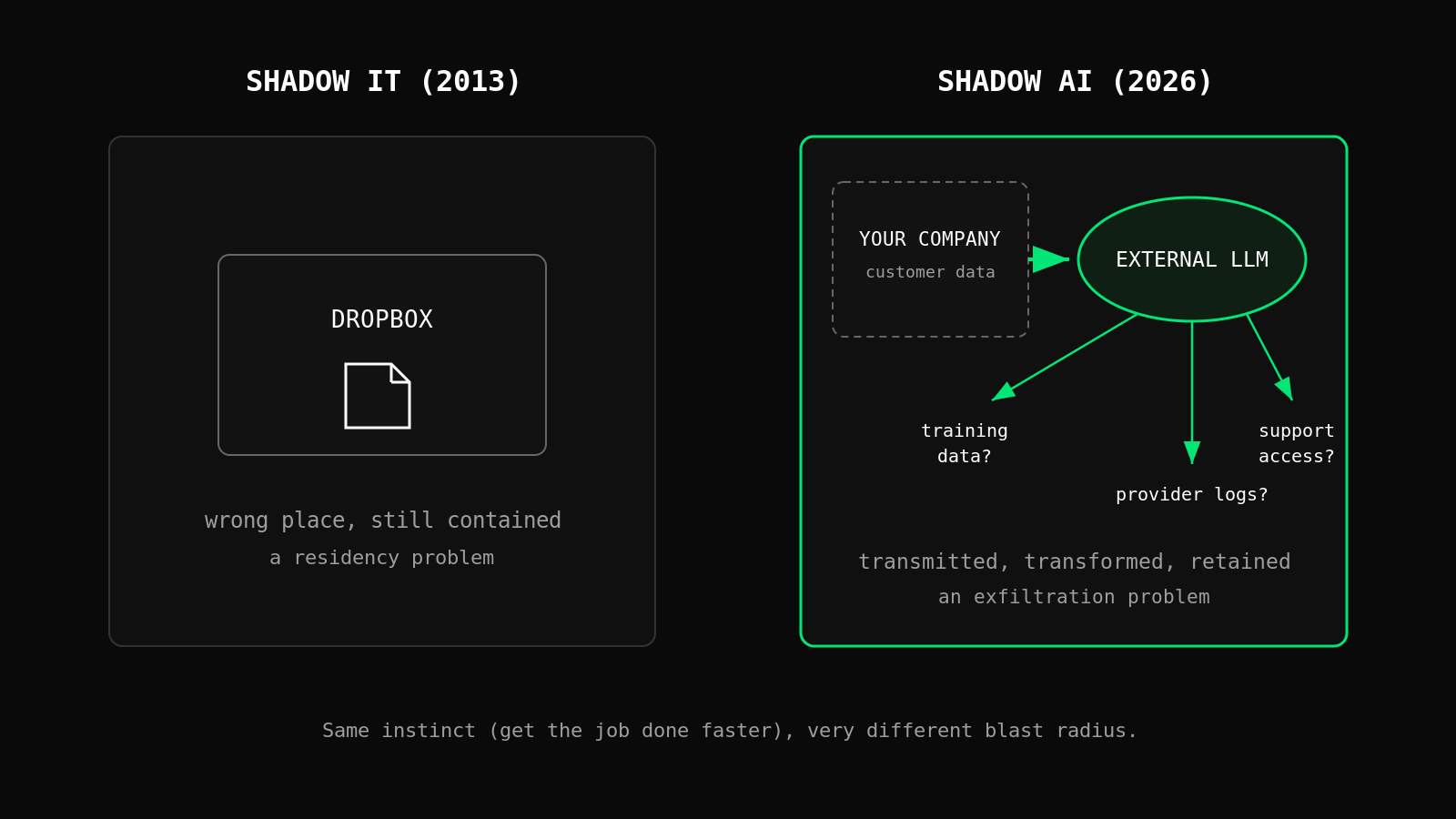
Shadow IT was mostly a data residency problem. Files sitting in Dropbox instead of your corporate file server. The data was contained; it just lived in the wrong place.
Shadow AI is a data exfiltration problem. When an employee pastes customer data into an external LLM, that data is transmitted to a third-party inference provider. Depending on the provider's terms of service, it may be used for model training. It may be stored in logs. It may be accessible to support engineers at that company.
The other difference is volume. A single developer who uses AI-assisted coding tools can generate hundreds of prompts per day. Each one is a potential data exposure event. The surface area is not comparable to a file on Dropbox.
The Discovery Problem
You can't govern what you don't know about. The first challenge with shadow AI is discovery: building a clear picture of which AI tools are being used, by whom, and with what data.
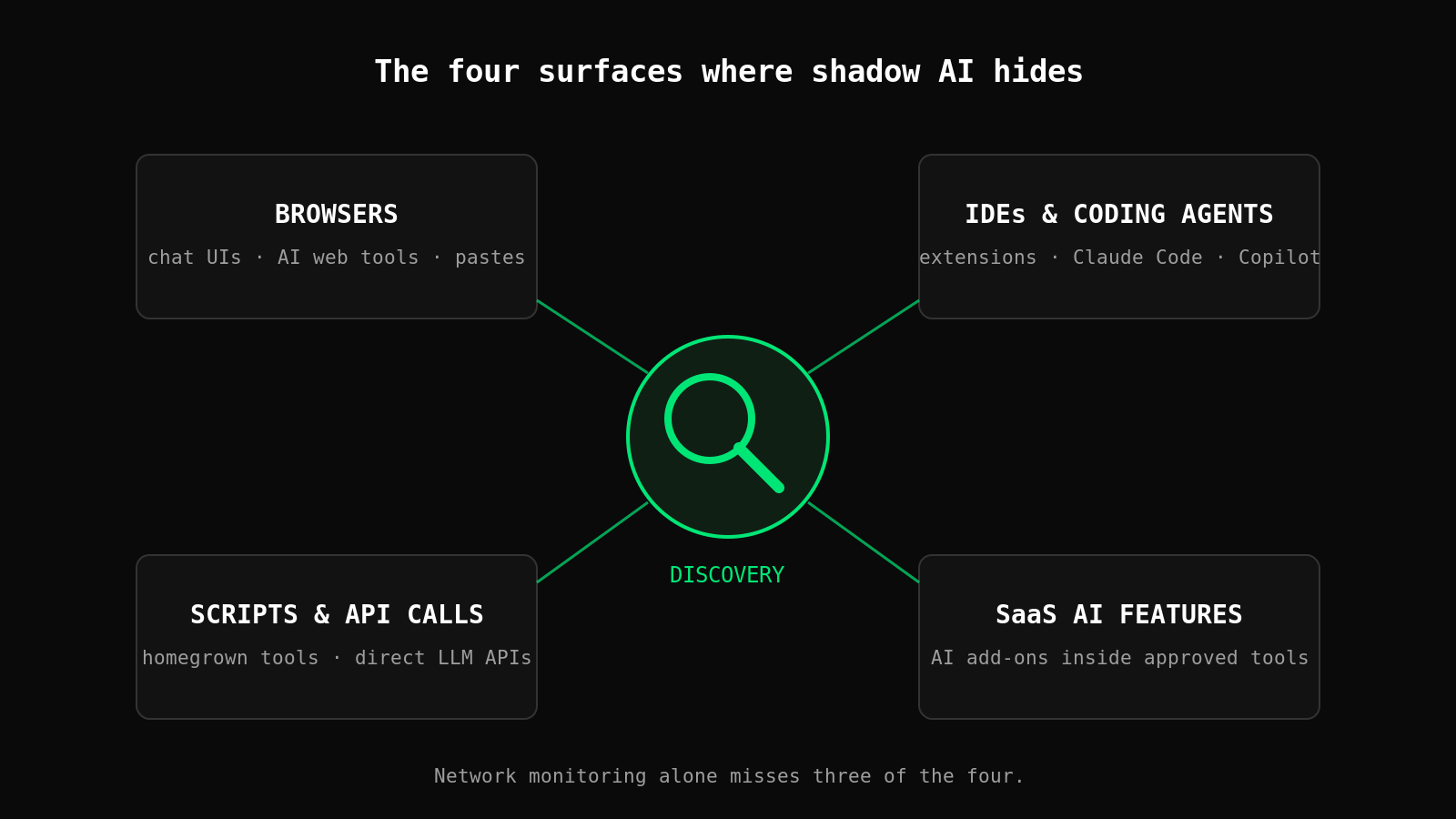
This is harder than it sounds. AI tools are accessed through browsers, through VS Code extensions, through API calls from scripts employees wrote themselves, and through SaaS products that have quietly added AI features to their UI. Traditional network monitoring doesn't catch all of these.
Effective shadow AI discovery combines:
- Browser extension telemetry: Capturing which AI-enabled websites and tools employees visit
- Network proxy analysis: Identifying API calls to known LLM providers
- Developer tool hooks: Surfacing AI usage in coding environments where proprietary code is most likely to be shared
- SaaS and billing audits: Catching the AI features and subscriptions that never touch your network at all, like an AI add-on quietly enabled inside a tool you already pay for
What to Do About It
Discovering shadow AI is a prerequisite. Governing it is the actual goal.
The mistake many organizations make is treating this as a blocking problem, adding AI tools to the deny list and hoping employees comply. This approach fails for two reasons. First, employees find workarounds; the concealment statistic above is what a blocking policy produces in practice. Second, it prevents the legitimate productivity gains that AI tools can deliver.
The more effective approach is channeled governance: make the sanctioned AI tools good enough that employees don't need to go around the perimeter, and apply a thin governance layer to all AI interactions, scanning for PII, enforcing data classification policies, and logging for audit purposes, without blocking the workflow.
This is the same playbook that worked for shadow IT. You don't win by blocking Dropbox. You win by making your internal file storage good enough to use, and by applying DLP policies that travel with the data regardless of where it lives.
Getting Ahead of It
The companies that handle shadow AI well share a few characteristics:
-
They measure before they restrict. The first ninety days are spent on discovery, not enforcement. You need to understand the actual usage patterns before you can design policies that fit them.
-
They communicate the why. Employees who understand why their company has AI policies are more likely to follow them. "We scan prompts for customer data to protect customer privacy" lands differently than "AI is prohibited."
-
They make the compliant path easy. If the approved AI tool requires three approvals and the unapproved one is one click away, people will take the easier path. Governance has to win on usability as well as security.
Shadow AI isn't going away. The tooling is too good and the productivity gains are too real. The question is whether your organization has a plan for governing it, or whether you're waiting for an incident to make that decision for you.
Want to put that thin governance layer in front of your own AI calls? Point your API base URL at the Control Zero gateway and its JSON traffic is scanned against 64 built-in detectors across 12 pattern packs before it reaches the provider, for any policy with PII detection enabled. No code changes. See the gateway guide.