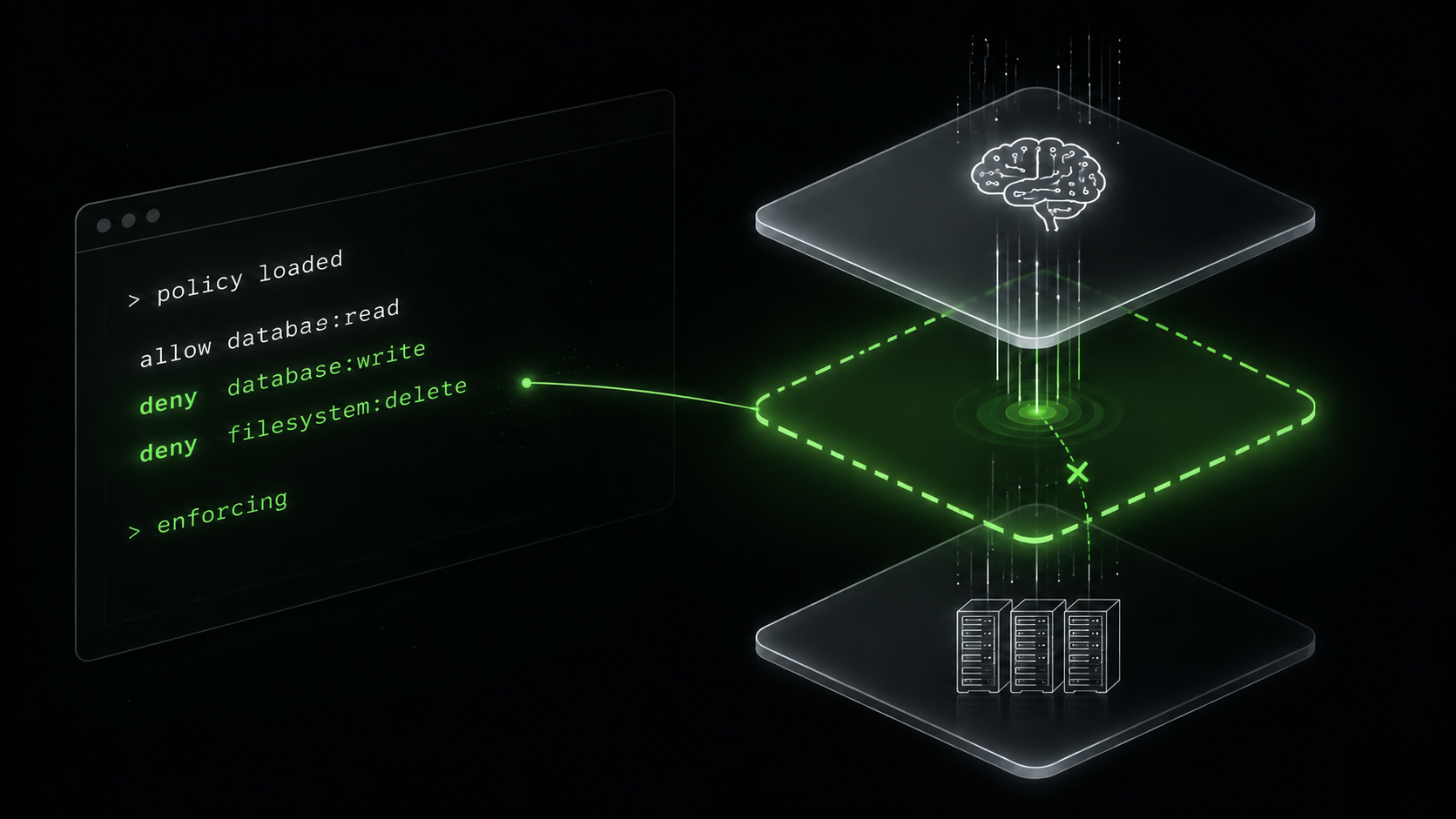
AI agents are no longer a research curiosity. They write code, send emails, query databases, call external APIs, and make decisions, often without a human in the loop. That shift from tool to autonomous actor changes everything.
The question companies are waking up to is not "should we use AI agents?" It's "who governs what they do?"
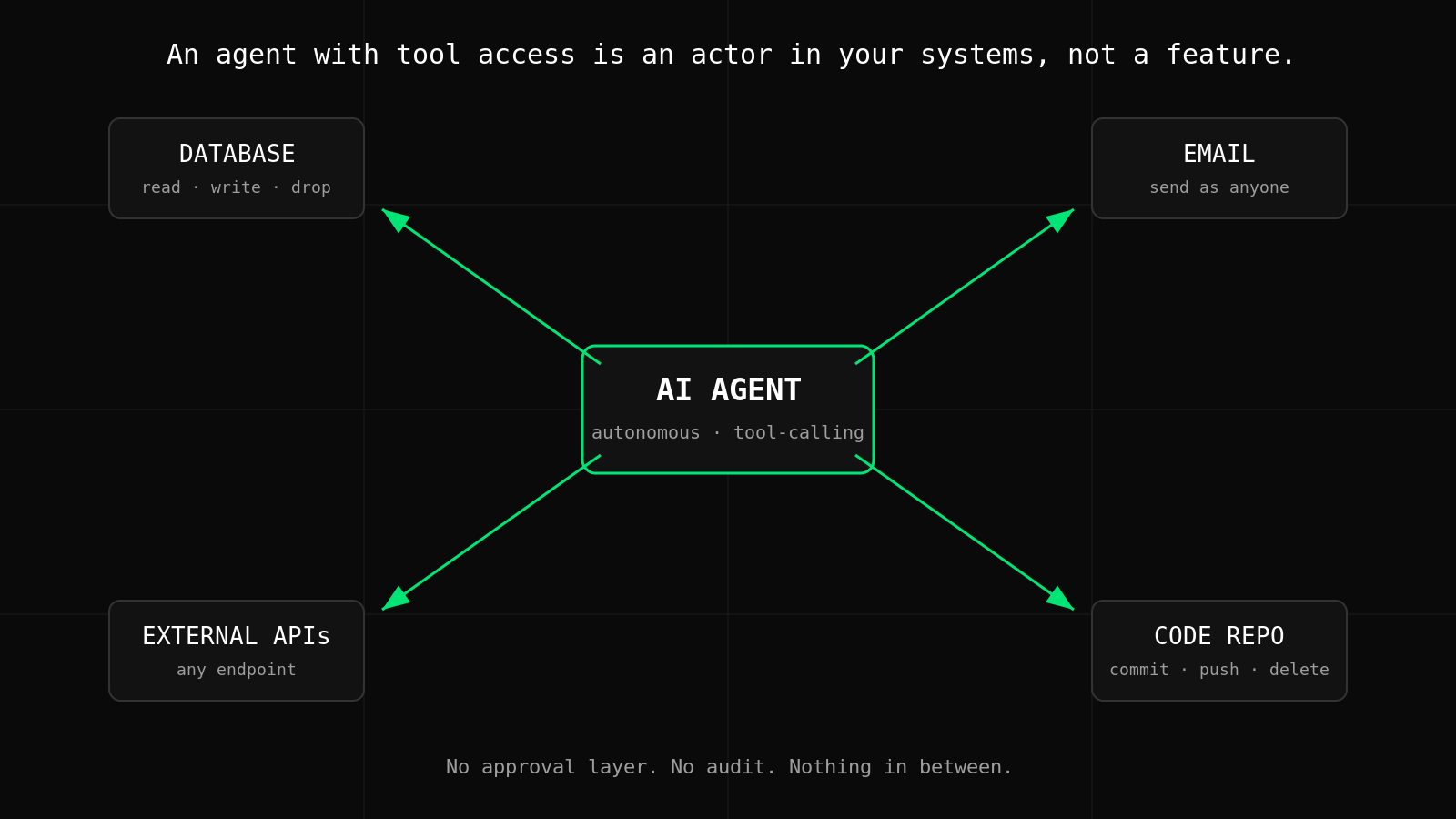
The Control Gap
When a developer writes code, every action is intentional. When an AI agent executes a task, the path it takes is probabilistic. The same prompt, on a different day, might produce a different sequence of tool calls. That's not a bug. It's the nature of language models. But it means you can't rely on code review or static analysis to catch every risk.
Traditional security tooling was built for deterministic systems. Firewalls, RBAC, DLP scanners: all of these assume you can list the inputs and outputs in advance. AI agents break that assumption.
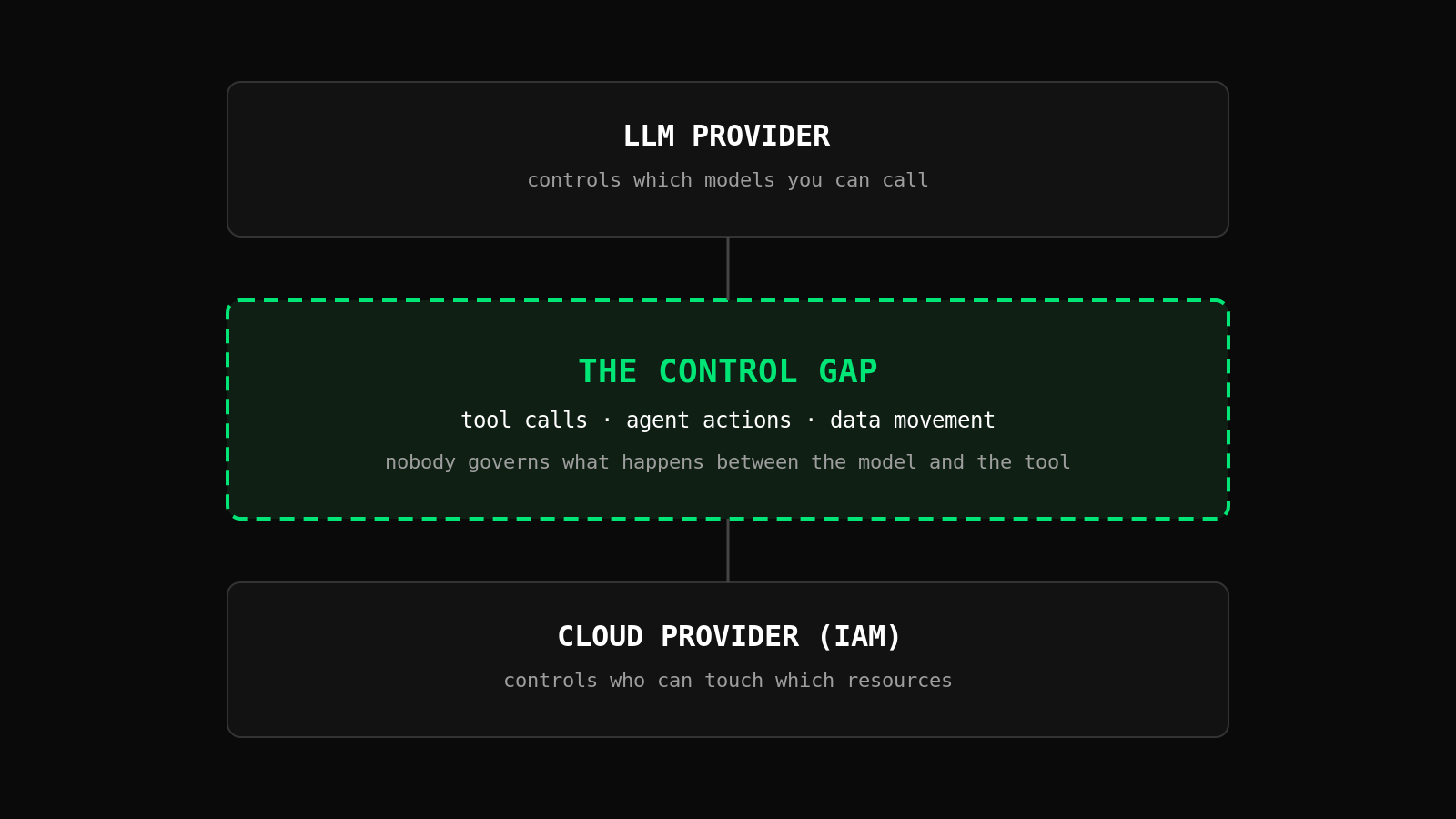
The result is what we call the control gap: the space between what an agent is capable of doing and what your policies actually prevent it from doing.
Here's a concrete version of that gap. Your LLM provider controls which models you can call. Your cloud provider controls who can touch which resources. Neither one sees the moment in between, when the model decides to call a tool and the tool executes. That moment is where data leaks, unauthorized actions, and surprise costs live.
What Governance Looks Like in Practice
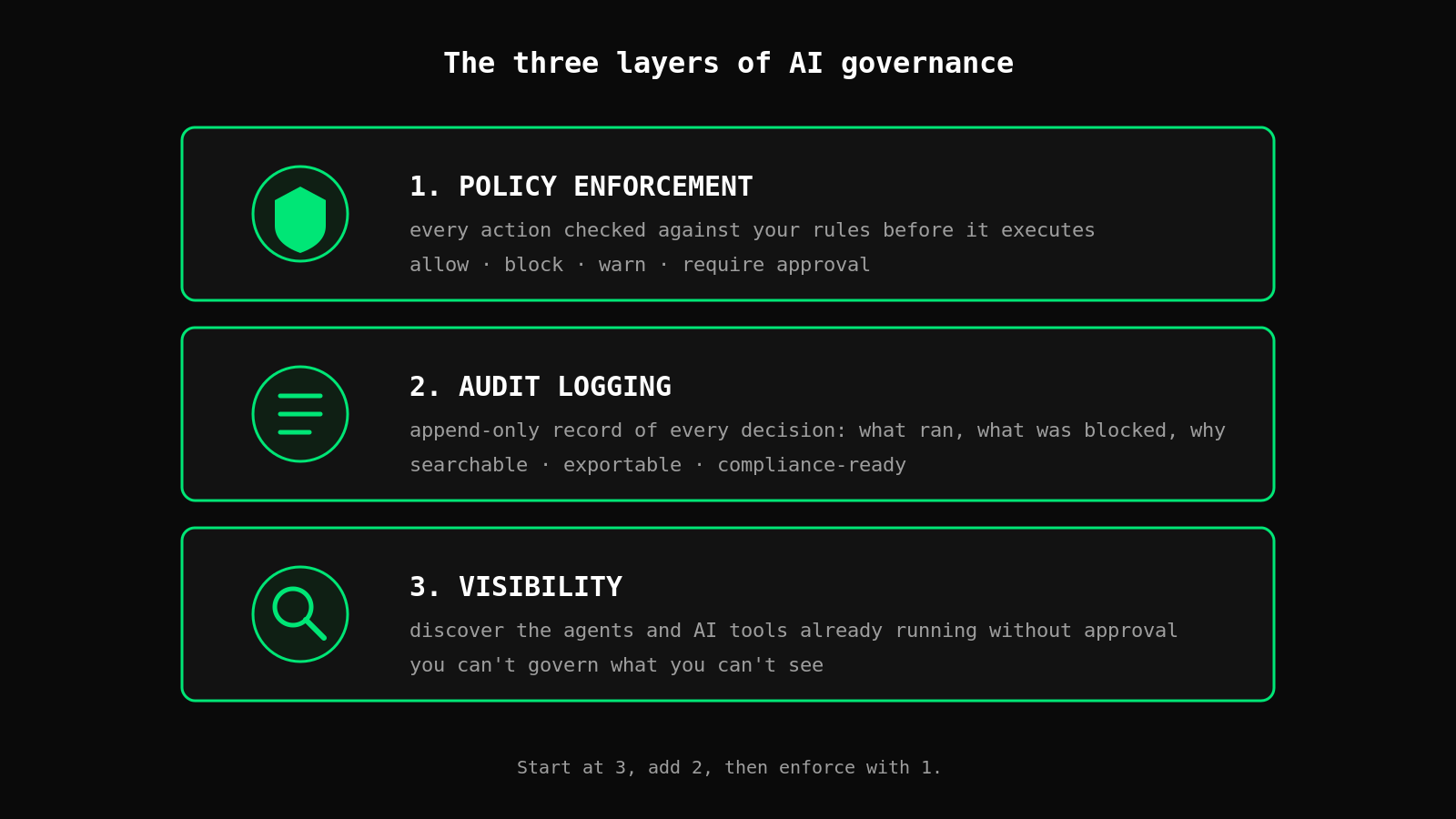
Effective AI governance operates at three layers:
1. Policy Enforcement Before an agent executes a tool call or sends a prompt, a policy engine evaluates it against your rules. Block requests that match PII patterns. Rate-limit calls to expensive models. Require human approval for irreversible actions. This happens at the SDK level, with no network round-trip and no latency added to the happy path.
2. Audit Logging Every action the agent takes is recorded in an append-only log. Not just the inputs and outputs, but the policy decisions: what was allowed, what was blocked, and why. When a compliance team asks "what did our AI do last Tuesday?", you have an answer.
3. Visibility Governance only works if you can see what's happening. Shadow AI, meaning models and agents that employees use without IT awareness, is a real problem at companies of every size. Recent industry surveys put the number of knowledge workers using unapproved AI tools at close to 80 percent. Discovery tooling that surfaces these agents is the first step toward bringing them into the governance model.
The Cost of Doing Nothing
Companies that skip this layer are making a bet. The bet is that their AI agents will never:
- Leak sensitive data through a prompt that gets logged somewhere unexpected
- Call an API they shouldn't have access to
- Accumulate costs that outpace the business value they generate
- Make an irreversible change that requires manual remediation
Some of those bets pay off. But as AI usage scales from one team to the whole organization, the probability of an incident compounds. And these incidents are no longer theoretical. Coding agents have deleted home directories with a single generated command, and employees paste sensitive data into chat tools every day. We have written up both: what --dangerously-skip-permissions actually turns off, and the real rm -rf incidents.
Starting Small
Governance doesn't have to mean complexity. The principle of least privilege, where agents get exactly the access they need and no more, scales from a weekend project to a regulated enterprise.
Start with logging. You can't govern what you can't see. Once you have a clear picture of what your agents are doing, layering on policy enforcement becomes straightforward.
The teams that are getting this right aren't the ones who waited until they had a compliance mandate. They're the ones who treated governance as infrastructure from day one, just like they did with authentication and access control a decade ago.
AI governance is going the same direction. The only question is whether you build it proactively or reactively.
Want to see what a policy feels like in practice? pip install controlzero runs locally with no account and no network. Write one allow rule and one deny rule, and watch the deny fire before the action ever executes. See the Control Zero quickstart.